
Post #1
Why I Created this Substack

This post is part of a series documenting my preparation for a new class at the University of Michigan Center for Entrepreneurship: “Postcards from the Future.” The class will be a study of technology-driven market disruption, with the current white-hot summer of AI providing a fascinating real-time context for discussions.
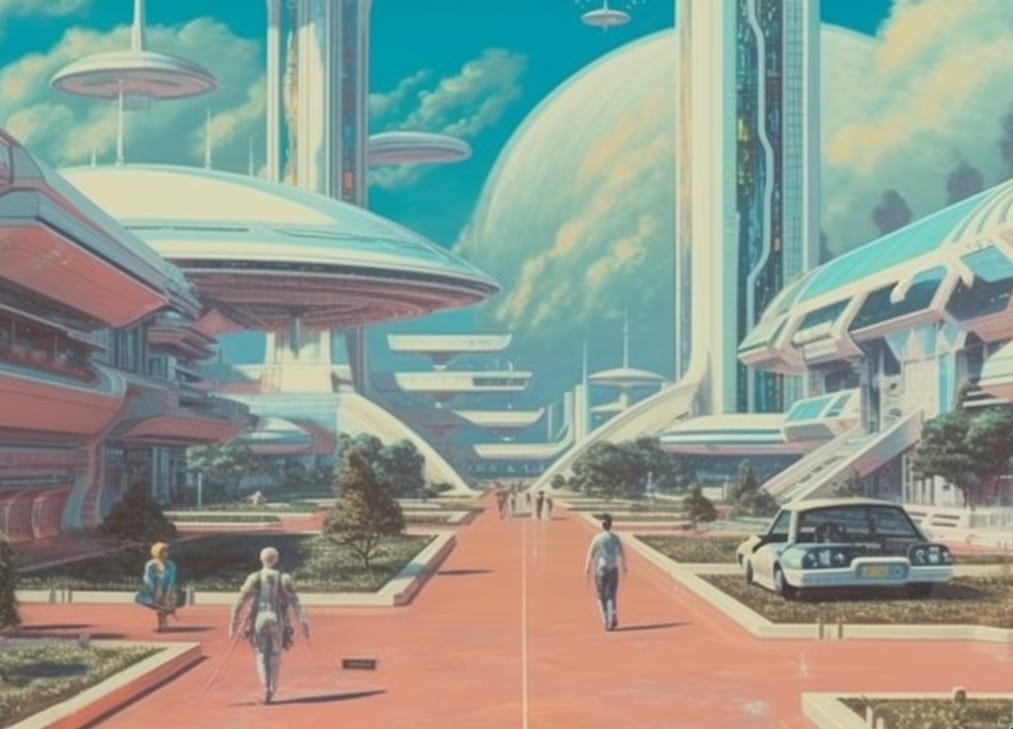
A postcard from the future - via Midjourney
Why Post #1 is Post #3
For the four of you who have been paying attention so far, this post really should be the first of the series. It’s coming out third because a) better third than tenth, and b) I’d rather write about pretty much anything other than my own background - the fun is in writing about new things! As I have committed to documenting this process publicly, and I really did start writing this post first, I will share it now, if only for the purposes of completeness.
I created this Substack as a way to share my thoughts as I develop a new class, “Postcards from the Future,” for the University of Michigan Center for Entrepreneurship (CFE). At its core, the class will be a study of technology-driven market disruption, with the current white-hot summer of AI providing a fascinating real-time context for discussion. Learning objectives for the class come from the core of our Entrepreneurship Curriculum. With a context provided by the exciting new developments in AI, we’ll explore the relationship between technology and product, drill down on value propositions; learn how to assess market timing and readiness; and discuss the ways AI may either change existing business models or create entirely new ones. The culmination of the class will be to try and predict where all these technology, market, and policy dynamics will lead us in 5-10 years.
My hopes in documenting this process publicly are threefold:
Provide an external motivator to keep the development process moving forward, and,
Run an interesting first-of-its-kind (for me) social experiment. As a consumer of social media since before the days of Netscape Navigator, I’ve never really put myself out there in this way - I hope it proves valuable
To drive awareness of this class in the broader CFE ecosystem.
Some Foundational Stuff:
I’m the Executive Director of the Center for Entrepreneurship at the University of Michigan. In that capacity, I have the great pleasure of overseeing a world-class program that is consistently ranked in the top handful of Entrepreneurship programs in the world, and includes a comprehensive catalog of for-credit courses supported by a deep and innovative array of hands-on experiential learning opportunities that engage thousands of undergraduate and graduate students at the University of Michigan every year.
I spent the first 30 years of my career in the venture-backed startup world: early on, as a founder, later on as “the guy who came in with the money,” and, most recently, doing turnarounds in venture portfolios. Mostly, I served as CEO, but I also held a few other CXO titles. Over the years, I had the good fortune to have multiple successful exits, including a public offering, alongside the very valuable (and humbling) life lessons associated with the creation of a few “craters” (Narrator Voice: you do learn more from failure than success). Mostly, I got to work with a bunch of super-talented people who wanted to do great things and try to change the world. Over the years, the companies I worked with raised something like $100M of venture capital.
Net: I have played the game for a while, have been in the middle of multiple global market cycles, and can provide a unique grounded perspective on AI-driven market change.
I Don’t Know Everything, But I Do Know Some Things
I reluctantly added this section because at least a part of the motivation for this course, and this Substack, is the cacophony of noise out there, and bullshit artists who are trying to make a quick buck off of fear and hype. I want to get beyond the noise to the big issues, the lasting impact, and the tough questions. The time frame for this class’ analysis is a few years in the future to eliminate from the conversation the inevitable short-term fear- and hype-enabled revenue models. Of course, questionable business opportunities always exist on the margins, and in times of rapid change even more so. People will make a ton of money off of fear or pure hype this cycle, and that’s not going to stop (in fact, I expect it will likely get worse for a period of time, because of these uniquely powerful tools in particular).
Sidebar on fear-mongering: I’m not going to call anyone out by name, but if I see another ex-Google (or Meta, Microsoft, …) mid-level manager preaching doom and gloom on major news channels, whose only qualifications are that they took a CS course in undergrad, might be able to spell “AI,” and they happened to walk by a company lab that was doing “scary AI-stuff,” I think I’m going to throw my laptop out the window.
As it turns out, I actually do know some things about AI. I was one of the first PhDs to graduate from the University of Michigan’s Artificial Intelligence Lab, studying under the amazing Dr. Ramesh Jain. My first company, Imageware, co-founded with Ramesh, was based on ideas coming from the AI Lab (the second company, Virage, came from AI Lab-incubated ideas too). As you can tell from my intro, I’m not a researcher - my professional life has been spent bringing early-stage, bleeding edge tech companies to market. And, there are lots of things I don’t know (just ask my kids). But, it’s no stretch to say that I’ve been commercializing AI for more than 30 years, and my opinions are grounded in those decades of watching this broad class of technologies evolve in the market.
Over the years, I’ve been a part of many complicated “but this new technology will take away jobs” conversations, at many of the biggest companies in the world, and on pretty much every continent. I’ve also been a part of many, many “this new technology allowed us to grow and add more people” conversations, and more than one “those people / that country can’t be allowed to get access to this new technology” conversations (weird stuff, for sure). And, I’ve been very, very fortunate to be a part of some “that work you and your colleagues did back then laid the foundations for my entire [career, business, industry]” conversations. Change isn’t easy, disruptive change is that much harder, but change really is the constant.
Why I’m Creating This Class
I could say that this class came about as a result of thinking about our ongoing curriculum review process and thinking of new ways to create some excitement around the study of value propositions and business models, but that wouldn’t be entirely true. This class started from almost purely selfish motives. I’d been watching the crescendo of AI hype over the past months, and thinking a lot about how this new-to-the-public technology is going to impact our world (note that I didn’t say “new technology” there, because, like a lot of overnight sensations, this current iteration is the result of decades of effort by many, many, many people), and I wanted to dig in even more. I wanted to get past the hype, fear, and froth in the market to where this is leading us. If only I was in a position where I could take some time and dig into current technology, market, and policy trends …
If you want to master something, teach it – Richard Feynman
Part of my attraction to joining the Center for Entrepreneurship was that I would have the freedom to engage in a variety of activities (advising, consulting, etc) vs. living the CEO’s 24/7 fiduciary responsibility of maximizing _one_ business opportunity (don’t get me wrong, I loved doing that work). But, thirty years of “focus, focus, focus on the opportunity in front of you,” is a hard habit to break, and it took an outside prompt: “you should teach a class on that!” to make me realize that following my desire to dig in wasn’t a distraction, it was, pretty much, exactly my job. Boom! Then the exercise became: could I put together something that had meaningful learning objectives and a reasonable pedagogical approach, and here we are.
K
This is a great and useful series, Kurt. One of my concerns is that, if these technologies are to lead to utopia rather than dystopia, there must be some people (perhaps MOST people) thinking, how can I apply this technology to make life better for xxxx community, rather than, how can I make big money implementing (or hyping) this technology. I hope that many of those postcards from the future will outline business models related to drastically improving education, health, mobility, etc.